
First Steps into Max/MSP:
Approaching a Complex Modular Programming Environment

At first, Max/MSP could be intimidating because of its interface. It’s no more than a software replica of a modular environment. You route oscillators, filters and delays (the grey/black boxes) and you can also manage midi signals.
A brief history
Originally named « The Patcher », Max is the result of a research led by Miller Puckette at the Institut de Recherche et coordination acoustique/musique (IRCAM) in the late 1980’s. Elaborated with public fund, the software was later commercialized by private companies, the most recent being Cycling’74. Max/Msp (named after Max Matthews and Miller Smith Puckette) is now bundled with Ableton Live as Max for Live but there is also its free elder brother, still regularly updated called Pure Data.
An old patch I did on pure data 2 years ago.
So many attempts and suddenly… a click
Last week, I made my 5th or 6th attempt to learn Max’s programming language. The last time I tried, I eventually gave up thinking : « Why should I continue ? I can already do everything with Ableton Live ». But, this last week attempt was different. It sstarted after I came accross an album by Erman Zoe (alias of the painter Damien Cadio). I loved his work on textures and realized that this richness eventually might come from modular techniques.
Considering how expansive modular gear is, I decided to try VCV rack. After two days virtually patching cables I thought : « Why not try Max/Msp ». This time, something clicked. I was determined to learn, helped by a comment I had seen on YouTube in which UserFriendlySounds said that one shouldn’t start patching with a precise goal in mind, but rather experiment and let things happen.
I wanted to build a randomized step sequencer or route reverb signals and weird effects in oscillators, which I can’t do on Ableton live (or maybe I ignore it?).
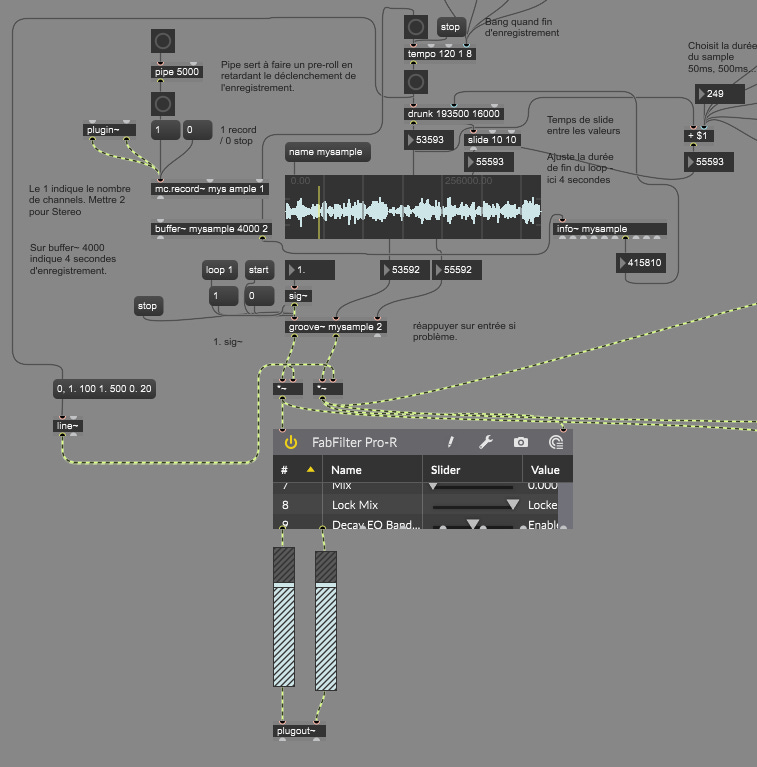
A story posted on my Instagram account showing one of my patches in the making.
I don’t enjoy learning through tutorials and prefer reading Max’s documentation. But, I found one on made by Oliver Thurley which is really good.
I also came across some Autechre sessions online, read what they had to say on several forums and learnt from them. They are considered as this software masters. Here is an example of one of their sessions:
Conclusion
After several days, I feel confident enough to continue. It feels surprisingly accessible. All I need is a computer, courage and a collection of my own recorded samples to play with.
Let’s see what happens next!